
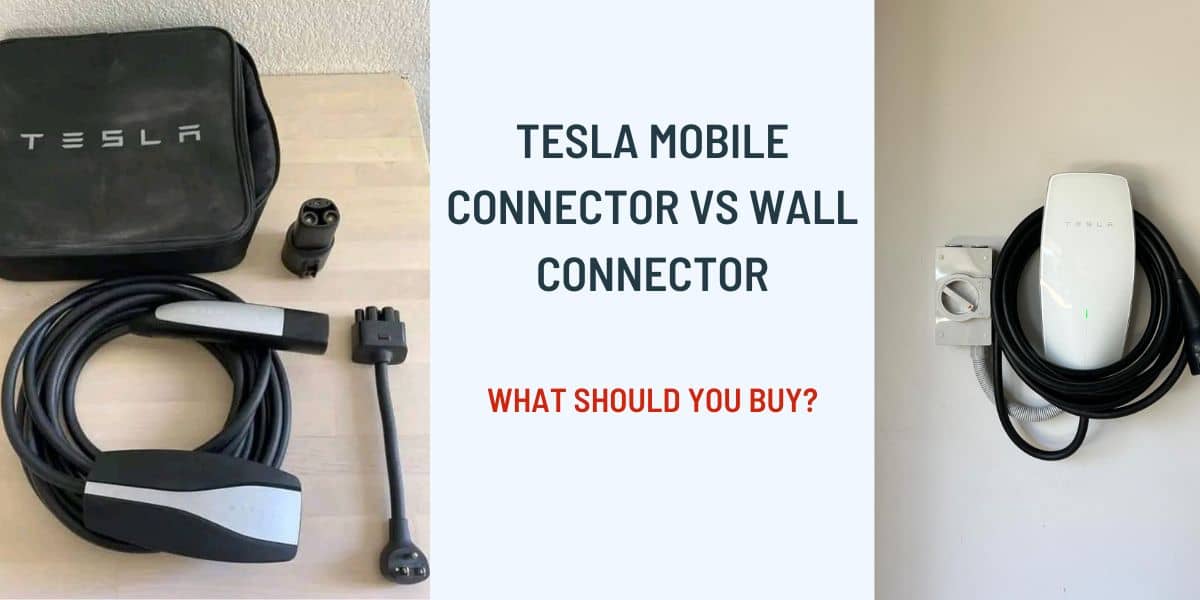
The mobile connector and the wall connector are two distinct charging options for Tesla cars. The mobile connector used to come with the Tesla cars, but Elon Musk recently stopped this. So, now, if you want to pick one of them, it might be hectic to choose.
But how do you compare it when it is about the Tesla mobile connector vs. the wall connector? The Tesla mobile connector gives you the flexibility to charge your vehicle anywhere. It has changeable adapters, so you can charge your vehicle from the regular home outlet. But the wall connector gives a faster charging speed.
I will elaborate on the pros and cons of each connector type and suggest the best option. Let’s get started.
Tesla Mobile Connector vs. Wall Connector: Comparison Chart
Before I go into the details, check the following chart for a quick comparison between the Tesla mobile connector and the wall connector.
| Properties | Mobile Connector | Wall Connector |
| Charging Speed | 4-30 miles of range per hour | 5-44 miles of range per hour |
| Maximum Amperage | 32 amp | 48 amp |
| Power Supply Compatibility | 120 volts / 240 volts | 208-250 volts |
| Power Sharing | Not available | Up to four shares |
| Variable Adapter | Yes | No |
| Suitable for | Indoor charging | Indoor and outdoor charging |
| Price | $230 | $475 |
What Is the Tesla Mobile Connector?
The Tesla mobile connector kit comes with a charging connector and variable adapter. Using the mobile connector, you can charge your Tesla from whatever outlet is available. For example, you can use the standard outlet at your home to charge your Tesla.
In the mobile connector bundle, you get the following items.
- The mobile connector cable with a length of 20 ft
- One standard 120-volt adapter for household outlets
- One 240-volt adapter with a 50-amp circuit breaker
- A nice bag to store the mobile connector and the adapters
With the mobile adapter, you can start charging your Tesla out of the box. There is no installation required for the mobile connector. Let’s check how the wall connector works.
What Is the Tesla Wall Connector?
The Tesla wall connector is a special hardware that you can install at your home or office and charge your vehicle at a superior speed. It is suitable for higher power supplies and comes with circuit breakers of up to 100 amps.
Once the wall connector is installed, indoors or outdoors, one hour of charging can give up to 44 miles of range. Wall connectors have a unique feature called Power Sharing, where you can charge up to four Tesla cars at the same time. I will talk more about it later.
If you encounter any issues with your wall charger, such as a red light, explore our guide on understanding the reasons behind and solutions for the Tesla wall charger displaying a red light. Take a closer look for valuable insights and troubleshooting tips.
Tesla Mobile Connector vs Wall Connector: Detailed Comparison

Let’s analyze the features of each connector type and see what benefits a Tesla owner the most.
Charging Speed
The main difference between the mobile connector and the wall connector is in their charging speeds.
# Mobile Connector
With the mobile connector, you get a lower charging rate. The mobile connector is suitable for power supplies with a lower voltage.
You get two adapters included with the mobile connector package. These are NEMA 5-15 and NEMA 14-50 adapters. The first one is a 120-volt and 15-amp adapter for common household outlets.
NEMA 14-50 is a 240-volt and 50-amp adapter, where you get a maximum output of 32 amps. There are some optional adapters you can buy separately/ These adapters support 120-volt or 240-volt outlets and have a maximum output of 12-32 amps.
Check the following chart to find out the charging speed of each adapter, depending on your Tesla model.
| Adapter Type | Adapter Volt and Amps | Charging Speed (Range achieved after one hour of charging) | |||
| Model 3 | Model S | Model X | Model Y | ||
| NEMA 5-15 | 120 volt / 15 amp | 6 miles | 5 miles | 4 miles | 5 miles |
| NEMA 14-50 | 240 volt / 50 amp | 30 miles | 27 miles | 23 miles | 27 miles |
| NEMA 6-50 | 240 volt / 50 amp | 30 miles | 27 miles | 23 miles | 27 miles |
| NEMA 14-30 | 240 volt / 30 amp | 22 miles | 21 miles | 17 miles | 21 miles |
| NEMA 10-30 | 240 volt / 30 amp | 22 miles | 21 miles | 17 miles | 21 miles |
| NEMA 6-20 | 240 volt / 20 amp | 15 miles | 14 miles | 12 miles | 14 miles |
| NEMA 6-15 | 240 volt / 15 amp | 11 miles | 10 miles | 9 miles | 10 miles |
| NEMA 5-20 | 120 volt / 20 amp | 7 miles | 7 miles | 6 miles | 7 miles |
# Wall Connector
On the other hand, the wall connector comes compatible with 240 volts and 15-100 amps of circuit breakers. The maximum output of the wall connector can vary from 12 to 80 amps. As a result, the charging speed is much faster with the wall connector.
With the most powerful wall connector, the Tesla Model 3 will achieve a range of 44 miles after just one hour of charging. As you can already see on the chart, the range after charging with the mobile connector for the same duration is 30 miles.
So, the wall charger has a 46.67% higher charging speed than the mobile connector.
Variable Adapter Options
The biggest benefit of the mobile connector is you can use a wide range of adapters. For example, you can use the common household adapter if you are charging the vehicle at home. If you are camping somewhere, you can use your RV to power up your Tesla. Even staying at an Airbnb isn’t a problem.
But the wall connector doesn’t have any variable adapter. So, you can’t charge with it anywhere. You have to come to the home or office or wherever the charger is installed. Alternatively, you can go to a Supercharging station, but nothing can beat the convenience of mobile connectors.
Versatility
The mobile connector is suitable for all Tesla models regardless of their onboard charger specifications. Even if the charging speed is lower, charging the vehicle won’t be a problem.
But you can’t take full advantage of the wall connector with all models. For example, the rear-wheel drive option on the Model 3 has a maximum charging capability of 32 amps. Even if the wall connector delivers more, the additional charging speed is of no use.
Power Sharing
This feature allows you to charge up to four vehicles simultaneously using the wall connector. The connector will intelligently divide the power into all available vehicles to ensure a balanced charging speed.
But you don’t have this luxury with the mobile connector. You can only charge one Tesla car with a mobile connector. However, buying more mobile connectors may be an option, but the wall connector wins in this segment.
Charging Location
The wall connector is extremely resistant to environmental elements, like heat or moisture. So, you can set up the wall connector anywhere you want. If you prefer outdoor charging, it is a better option.
But, the mobile connector is only suitable for indoor charging.
Price
You can order the mobile connector for $230 from the Tesla website. But the wall connector costs $475. This is a huge price leap for fast charging.
What Should You Buy Between Tesla Mobile Connector and Wall Connector?
It depends on your usage, required range, charging preference, etc. If you need short ranges with the ability to charge the vehicle anywhere, the mobile connector is better.
But if you drive the vehicle a lot and need to charge it faster, the wall connector is the best option.
FAQs
Check answers to some commonly asked questions about Tesla mobile connector vs wall connector.
The mobile connector has some sort of water resistance, but it isn’t waterproof. So, you shouldn’t use it outdoors.
Of course. You can take advantage of the off-peak hours with the wall connector and save some energy bills.
Yes. The wall connector draws a maximum of 19.2 kW. But it is only 7.7 kW for the mobile connector.
Final Thoughts
As long as mobile connectors came with the car, many people didn’t give a thought to it. But mobile connectors aren’t free now. So, it is crucial to understand the differences between Tesla mobile connectors and wall connectors when you are purchasing between them.
The mobile connector is portable and requires no installation. You can charge the vehicle anywhere with the mobile connector. But it has a lower charging speed.
The wall connector is more compact and has a faster charging speed. But it requires installation and costs more than double the mobile connector. So, the choice boils down to your driving pattern, charging requirements, and budget.

I am an experienced guide in electric mobility, offering clear and expert guidance for those venturing into the world of electric vehicles.
Through collaborations, research, and hands-on experience, I navigate readers through the evolving landscape of smart automobile technologies and the significance of renewables.